

Aero L-39/L-139/L-59/L-159
This Czechoslovak design was once the most popular jet training aircraft in the world, due to it being the preferred advanced trainer in the Sovjet block. The Soviet air force alone operated nearly a thousand L-39 Albatroses. You are still likely to encounter one, as many have ended up on the civil market as warbird.
The L-39 has straight, low mounted wings with tip tanks as standard. Above the leading edge are long D-shaped air intakes at the side of the fuselage, slightly tilted inward. They have a rectangular splitter plate in front. This is one of the key features of the Albatros. Another one is the gear. The single wheel main landing gear has trailing link legs, allowing soft landings, even on grass. The nose gear is also of a trailing link type. For the rest the L-39 is not very extraordinary, but here are the other characteristics: a tandem cockpit, pointed nose, tall vertical stabiliser and the exhaust beyond it.

The long D-shaped, slightly tilted air intakes at the side of the fuselage are one of the key features of the Aero L-39 Albatross, except for the first prototypes.

The main landing gears do not have straight legs, but a trailing link, so with a bent. This allows operations from grass runways and other rough surfaces.
How to recognise the different versions of the L-39, L-59, L-139 & L-159
The different versions of the Albatros can externally be distinguished by amongst others
- the number of pylons under the wings
- the shape of the nose
- the shape of the canopy and how it opens
- the presence of a gun pod under the front fuselage
- the shape of the air intakes
- the presence and size of tip tanks
- the shape of the vertical fin, in particular the top
- the number of seats
- the presence of a ram air turbine under thefront fuselage
- the antenna configuration
L-39 first prototypes
Five flying prototypes of the L-39 were built, that already look very similar to the production aircraft. Only the first three prototypes differed in having a wider, less tall D-shaped air intakes. They have a wider splitter plate in front, and three small auxiliary intakes in the lower half of the intake, just behind the inlet lip.
L-39C
The initial basic trainer version of the Albatros received the factory designation L-39C, with the C standing for Cvičná – training. Initially it was just L-39, until other versions appeared. It has a maximum of one pylon under each wing. However, often no pylons are visible at all, and then the L-39C is more difficult to distinguish from the other variants except the L-39 Skyfox, L-59 and L-159. The canopy has a non-canted bow frame, and opens sideways in two parts.

Many L-39Cs have ended up on the civil market, flying as warbirds like this example. It has dummy missiles under the single wing pylons.
L-39CM & L-39M1
A modernised version of the L-39C is called L‑39CM in Slovakia. A similar upgrade in Ukraine is known as L-39M1. The changes appear to be largely internal, with the head-up display (HUD) for the front seat being externally visible.

If you look closely at the front cockpit the HUD of this L-39CM is clearly visible. Also the single pylons under the wings are obvious.
L-39CW
As a step towards the L-39 Skyfox Aero developed the L-39CW. Initially, it was an L‑39C with just a new engine. In this stage, the L-39CW is hardly distinguishable from the original L-39. Later it received wings without tip tanks. In both cases, the canopy remained the one of the original L-39, opening sideways in two parts.

Shown here is the first step in the development of the L-39NG, the L-39CW with just a different (Williams FJ44) engine. The tip tanks are still there, making it difficult to distinguish from the standard L-39. (photo: mossback/WikiMedia)
L-39MS
Superficially, the L-39MS (Modernised Super) looks very similar to the L-39ZA with its gun pods and four underwing pylons, but when you look closer there are noticable differences. The easiest visible one is the canopy, that opens upward in a single piece. The bow frame in between the two seats is canted. Furthermore, the L-39MS has the longer tip tanks. The nose is also longer and more pointed, but the difference of 10 cm is hardly visible, even when compared side-by-side with the L-39ZA.
L-59 is the designation for the basic export variant of the L-39MS, that is externally the same as the L-39MS. The actual built examples, L-59E and L-59T differ from the basic L-59. See below.

At first the L-59 looks very similar to the L-39ZA, but it has longer tip tanks and a canted bow frame in the middle of the canopy.
L-39NG Skyfox
Skyfox is the marketing name for the significantly modernised version of the L-39, also known as L-39NG. It is the production version the L-39CW development aircraft. Compared to the original, the Skyfox has no tip tanks. There can be two pylons under each wings. It has a single piece canopy with canted middle bow frame like on the L-39CM and L-59 (but opening sideways). The rear canopy frame is more curved though and the canopy ends higher, transitioning in a sort of dorsal spinal. The air intakes therefore appear to have more distinctive channels.

The L-39NG Skyfox still has the basic lines of the original L-39 Albatros, but has a different canopy, dorsal spine and no tip tanks. (photo: Admiralis-generalis-Aladeen/WikiMedia, modified)
L-39V
The V suffix of the L-39V points at the main task of this version, target towing or Vlečná in Czech. The cable winch is stored where normally the rear seat is located, although this is not visible except when looking into the cockpit from above. Under the front fuselage, is a small streamline body for the ram air turbine that provides the power for the winch.

With the canopy being blinded you cannot see that the rear seat is missing in this L-39V. The streamline body for the ram air turbine below the cockpit is visible though. (photo: Alan Wilson/WikiMedia)
L-39ZA & L-39ZAM
Even more than the L-39ZO, the L-39ZA is the dedicated light attack version of the Albatros. This variant has two pylons under each wing, and in addition a gun pod under the front fuselage. This gun pod can in principle be removed, but this is hardly done.
L-39ZAM is a modernised version with a head-up display. Likely it is very difficult to recognise from the standard L-39ZA, because from the outside the gun sight and HUD look very similar.

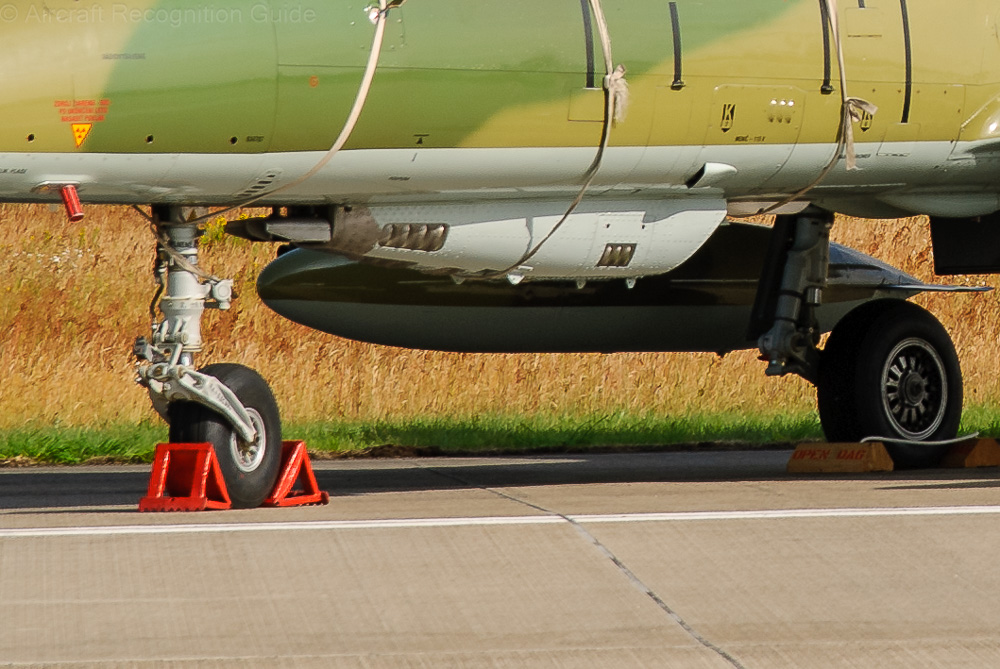
L-39ZA/ART
The Thai air force version of the L-39ZA has Israeli and western avionics. It is called L39ZA/ART. Externally, the ZA/ART variant can be distinguished from the regular ZA version by a rectangular blade antenna under the rear fuselage.

The blade antenna under the rear fuselage is the main distinguishing feature of the L-39ZA/ART compared to the standard L-39ZA. (photo: USAF/WikiMedia)
L-39ZO
Compared to the L-39C the L-39ZO has two pylons under each wing. It can be considered as a basic weapons trainer, with the Z in the designation standing for Zbraně. Unlike the L‑39ZA above the L-39ZO has no gun pod under the fuselage.

The four underwing pylons and the lack of a gun pod under the front fuselage are clear clues that this is an L-39ZO. (photo: Aldo Bidini/WikiMedia)
L-59E & L-59T
These are dedicated export versions of the L‑59, the L-59E for Egypt and L-59T for Tunesia. Compared to the basic L-59 both have a taller vertical fin, with a horizontal bar in front of the top of the rudder, containing formation lights.
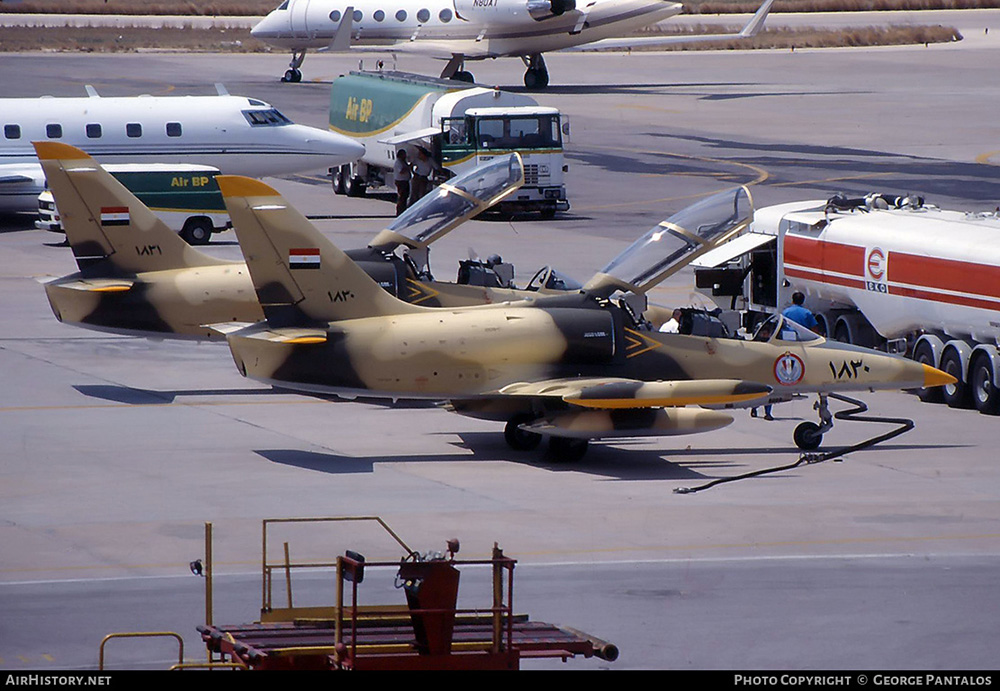
The light stripe near the top of the taller vertical stabiliser are clearly visible on this Egyptian L-59E. (photo: George Pantalos, used with permission)
L-139
The first attempt to make the L-39 more appealing for western air forces resulted in the L-139. Externally, this looks much like the L‑39ZO with its two pylons under each wing and no gun pod. The western TFE731 engine and western avioncs do not lead to a different appearance. However, the L-139 has the taller vertical stabiliser of the L-59E and L-59T, but retains the original two piece canopy. Additionally, it has an extra 'hockey stick' antenna on top of the fuselage, behind the cockpit, and a wire antenna from the niddle of the fuselage to the top of the vertical fin. So this is what to look for.

The one and only L-139 built has a wire antenna from the top of the vertical stabiliser to the top of the fuselage, and a blade antenna in front. For the rest it looks much like the original L-39. (photo: Fred Willemsen, used with permission)
L-159A ALCA & L-159E Honey Badger
The ultimate version of the L-39 frame is the L-159, of which the main version is the L-159A ALCA (Advanced Light Combat Aircraft). The L-159A is a single seat airplane in which the rear seat has been replaced by an avionics box. The bottom of the rear canopy (the sill) is lower than that of the front canopy; they are not in line. The front canopy opens to the right. Additionally, the L-159 has a longer, not so pointed nose. Below is a distinctive blade antenna. The tail is like that of the L-59, so taller than on the L‑39. Also, the air intakes are supposed to be larger, but that is difficult to see. Finally, the L‑159A has three pylons under each wing and a single one under the fuselage, behind the nose gear.
L-159E is the export designation of the L-159A, which is used by Draken International and named Honey Badger by them.


L-159B, L-159T1, L-159T1+ & L-159T2
These are all two seat versions of the L-159. Their canopy opens up in one piece, like on the L-59. For the rest the L-159B, T1, T1+ and T2 have the long, blunt nose of the L‑159A, as well as the three underwing pylons. Mutually, they seem to be externally the same.


This L-159T1 shows its large, single piece canopy that opens up. Like the L-159A it has three pylons under each wing. (photo: Alf van Beem/WikiMedia, modified)

Similar aircraft
Some airplanes look so similar to the L-39 that you may confuse them. Below you can read how to distinguish them.
Differences L-39 & UL-39 Albi

This scaled-down light sports aircraft version of the L-39 obviously look most like the real deal. It has a ducted propeller in a wider fuselage to power the airplane. The air intakes are much larger than on the L-39 itself.
Differences L-39 & CASA C-101 Aviojet

The Aviojet has a landing gear and and forward fuselage like the Albatros. The air intakes are placed in front of the wings and have a long oval shape. Additionally, it has no tip tanks. Finally, the exhaust is under the tail, before the end of the fuselage.
Differences L-39 & K-8/JL-8

The Chinese/Pakistani K-8 has a similar appearance as the L-39, except for three key features of the latter. The K-8 has less rounded air intakes and placed further forward. In addition, the landing gears are straight and the K-8 has no tip tanks. (photo: Bob Adams/WikiMedia)
Differences L-39 & AIDC AT-3

This is a twin engine jet trainer with engines at the sides of the fuselage, lacking tip tanks and having straight landing gear legs, but for the rest it looks quite similar to the L-39.
Differences L-39 & Aermacchi MB339
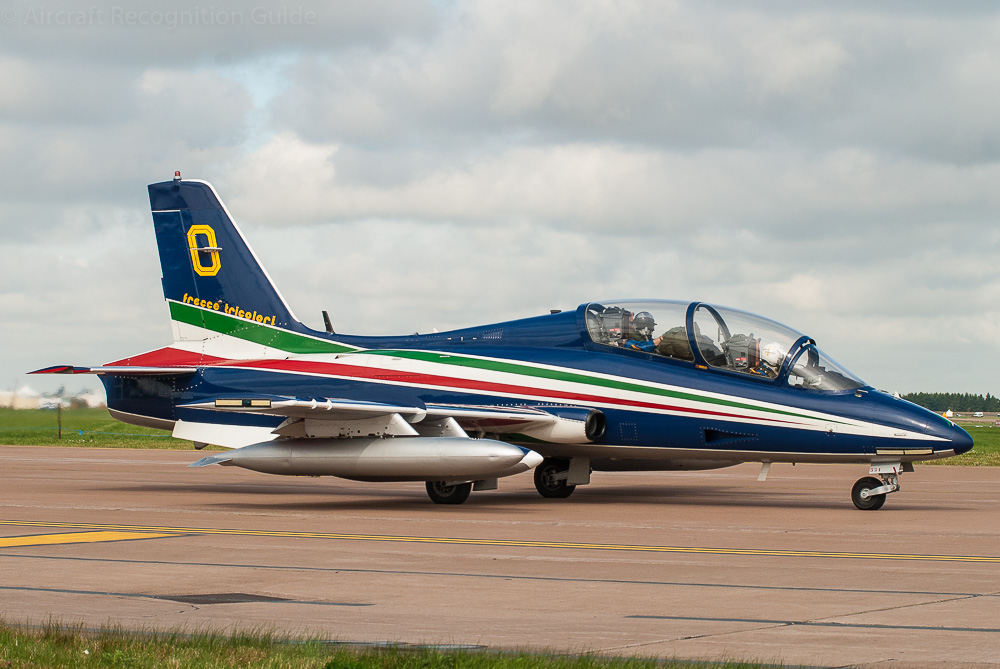
The canopy, trailing link gear and straight wings are similar to that of the L-39 (albeit without tip tanks), but there are many difference in other parts. The landing gear of the MB339 is shorter and the air intakes in the wing roots are much smaller and nearly round.
Differences L-39 & British Aerospace Hawk

The Hawk has smaller air intakes, more D shaped, swept wings, a curved leading edge of the tail and horizontal stabilisers with anhedral. This should be enough not to mix it up with the L-39.