
Chengdu J-10
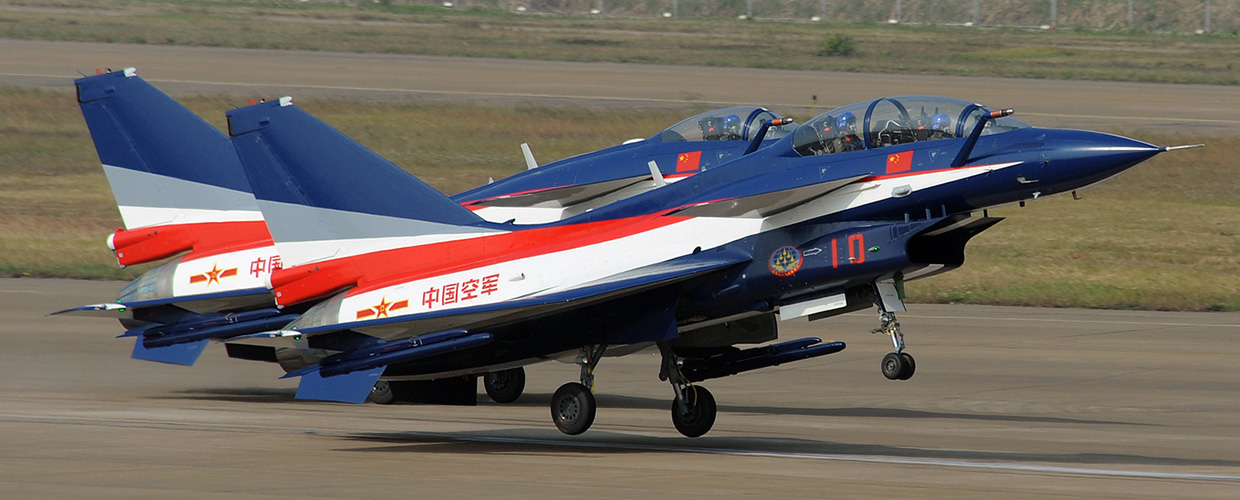
China's major leap in fighter technology took quite a while, starting in the 1980s. The Israelis, that had given up on the Lavi, significantly helped the Chinese. The result was the J-10, ‘Vigorous Dragon’. The NATO reporting name for the fighter is Firebird. Like the Lavi, but also the Eurofighter Typhoon, the J-10 has large delta wings with canards immediately in front. There is a single air intake under the forward fuselage, with a more or less rectangular shape with rounded corners. The gear consists of a double wheel nose gear (with tiny wheels), retracting rearward, and single wheels main gears retracting forward. Above the exhaust of the single engine is a cut-off triangular vertical fin; below are two ventral fins. (top photo: Peng Chen/Wikimedia, modified)
How to recognise the different versions of the J-10
The different versions of the Chengdu J-10 can be distinguished by:
- the size of the canopy
- the shape of the air intake
- the presence of an infrared sensor in froint of the canopy
- the shape of the exhaust
- the shape of the top of the vertical fin
- the number and location of blade antennas
- the presence of a pitot tube at the tip of the nose
- the presence of a cannon under the air intake
J-10A & J-10AH
The J-10A was the first production version of the J-10, and is a single seater. The air intake has a movable splitter plate against the underside of the fuselage. The inside of the intake is clean, unlike that of the J-10B and on. Below the air intake, on the left side of the nose gear, is a single cannon. Other main features are a pointed nose cone with pitot tube, a straight top of the vertical stabiliser and non-swept trailing edges of the ventral fins. There could be removable non-retractable refuelling probe on the right side of the nose.
The land-based naval version is externally not different from the J-10A.

The single seat J-10A has a straight top of the vertical stabiliser and non-swept trailing edge of the ventral fins. (photo: Li Pang/Wikimedia)
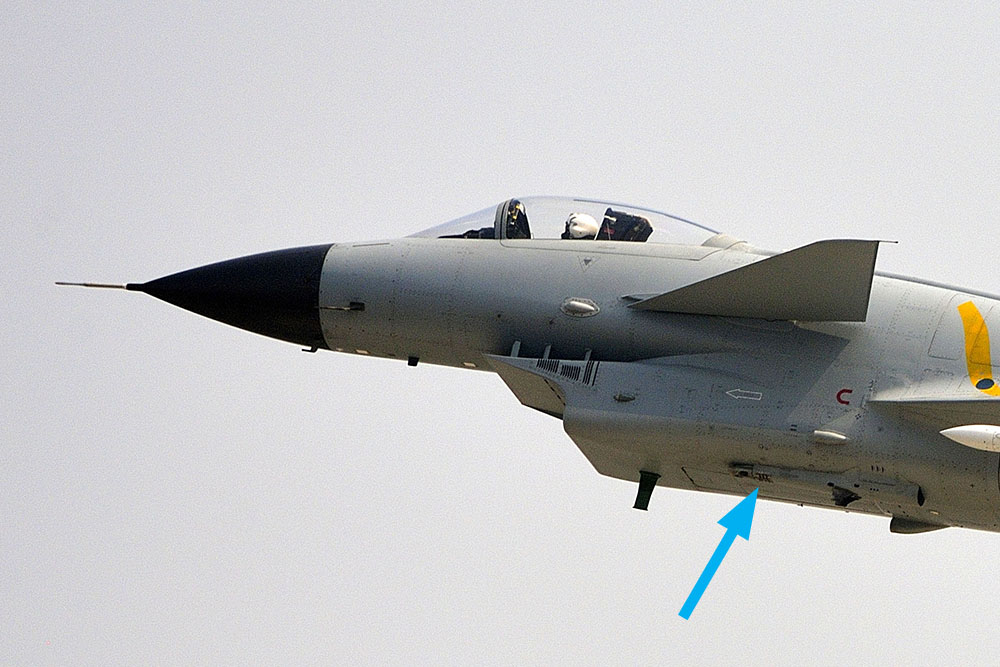
A close-up of the front of the J-10A better shows the splitter plate in front of the air intake and the pitot tube on the nose. The arrow points at the single cannon of the J-10A. (photo: 中華民國國防部/Wikimedia, modified)
J-10AY
This J-10A subtype is a specialised version for the PLAAF demonstration team Ba Yi. Unlike the standard J-10A is has no cannon under the air intake. Moreover, it likely has smoke generators on pylons under the outer wings.

The Chinese demo team Ba Yi had a special version of the J-10A, called J-10AY. It has no cannon under the air intake, but that is difficult to see here. (photo: Aktug Ates/WikiMedia)
J-10B
A major upgrade resulted in the J-10B, although this was just an intermediate step towards the J-10C that followed soon. On the outside the most prominent changes are in the air intake and tail area. The air intake has lost the splitter plate in front. To regulate the air flow, there is now a spherical body inside the intake. From the side you can also recognise this type of intake by the backward canted front. The vertical stabiliser of the J-10B has a pointed tip above the larger rectangular antenna, becoming more similar to that of the Eurofighter Typhoon. Additionally, the trailing edge of the ventral fins is swept forward. Finally, the J-10B has no pitot tube at the tip of the nose cone, but there is a sensor on top of it, in front of the canopy. Other differences are in the small antennas configuration.
One J-10B was fitted with a thrust vectoring nozzle. It is unclear whether this had a different designation.
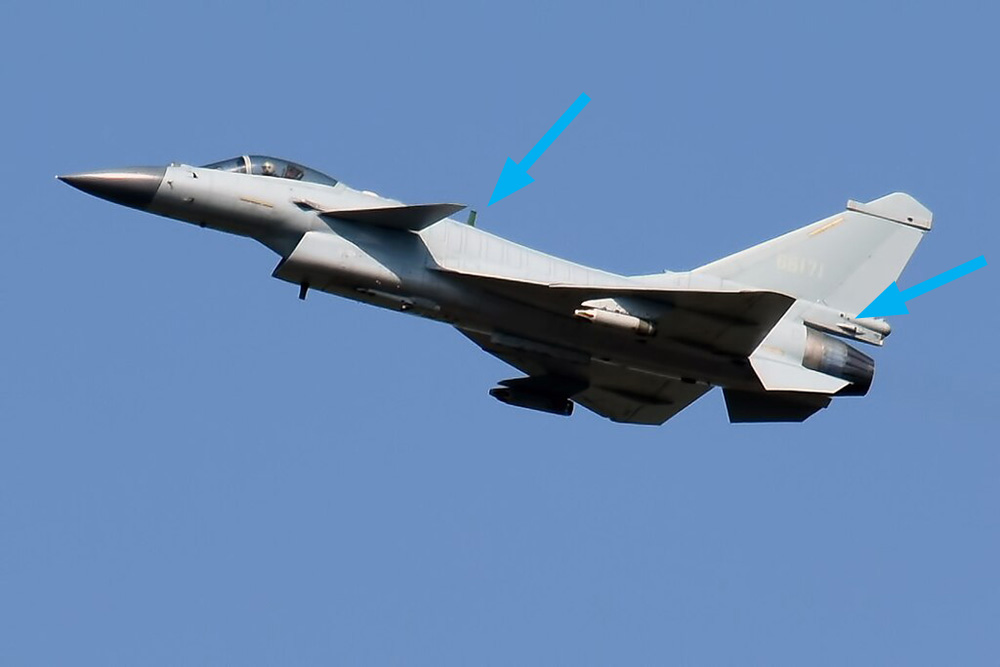
The J-10B has a pointed top of the tail, canted air intake and forward trailing edges of the swept ventral fins. The arrows point at the antenna configuration characteristic for the J‑10B. (photo: Anna Zvereva/Wikimedia, modified)
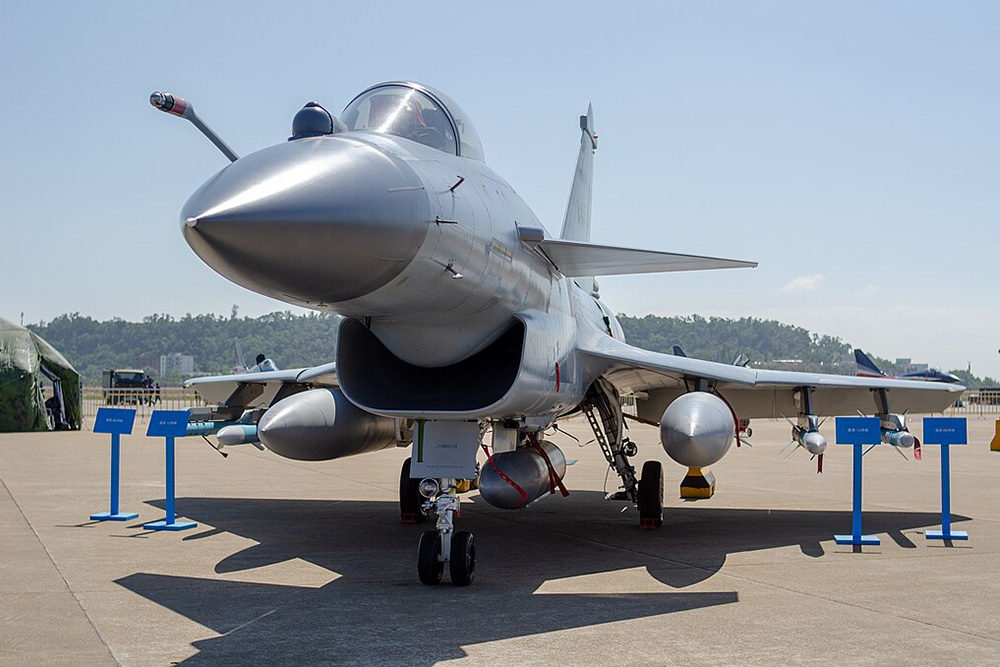
From the front you can well see the round shape in the air intake that is typical for the J‑10B (and J‑10C). Also note the sensor on top of the nose. (photo: 乘号同学/Wikimedia)
J-10C
The main difference between the J-10B and J-10C is in the nose, as the J-10C has a different radar. This is not visible on the outside though; you’ll have to look at the antennas. The J-10C has three large blade antennas on top of the fuselage, whereas the J-10B only has one. Furthermore, J-10C has a small bulge on the side of the rectangular antennas in the top of the vertical fin, which seems to have moved from the side of the tail cone above the exhaust nozzle.
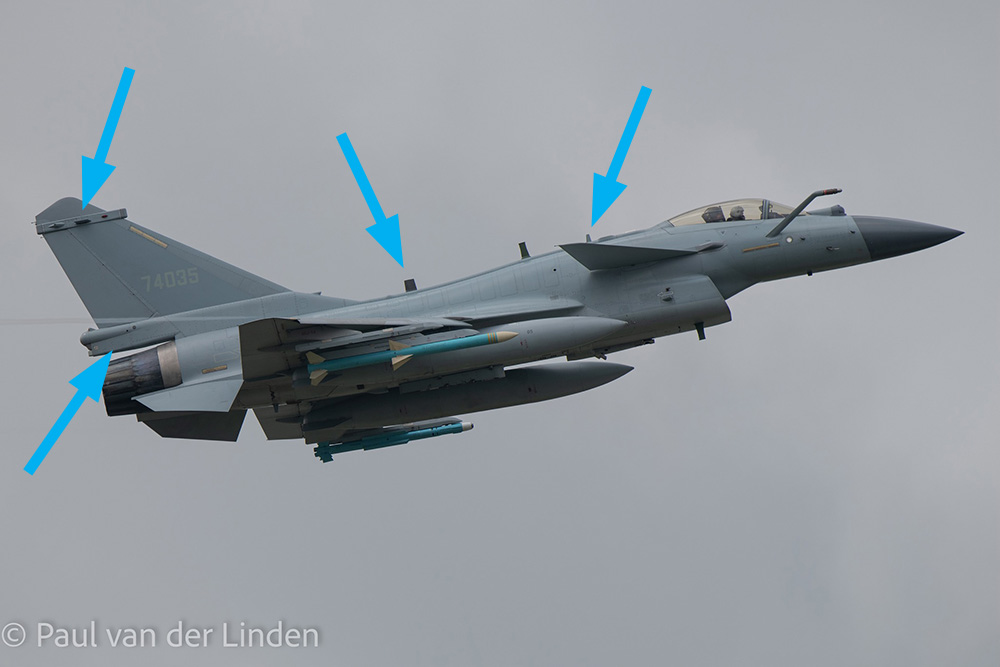
The four arrows mark how the antennas of the J-10C are different from those of the J-10B's. (photo: Paul van der Linden, used by permission)
J-10CE
J-10CE is the export version of the J-10C. Like often, it is slightly different from the domestic version. For the J-10CE it translates in having a blade antenna less. The one immediately in front of the vertical fin is missing.
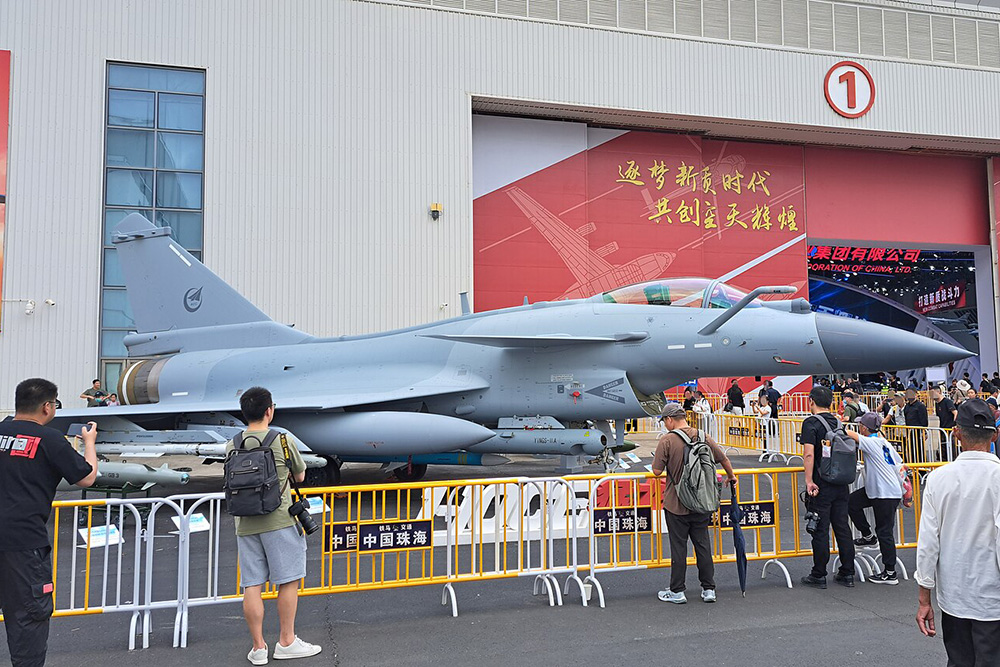
The J-10CE export version is mostly externally equal to the J-10C, except for the second long blade antenna in front of the vertical fin. (photo: Z3144228/Wikimedia)
J-10CY
The demonstration team has upgraded to the J-10C as well. Likely it has no cannon, just as the J-10AY hasn’t. It has however a larger dorsal spine, the only single seat version to have that.
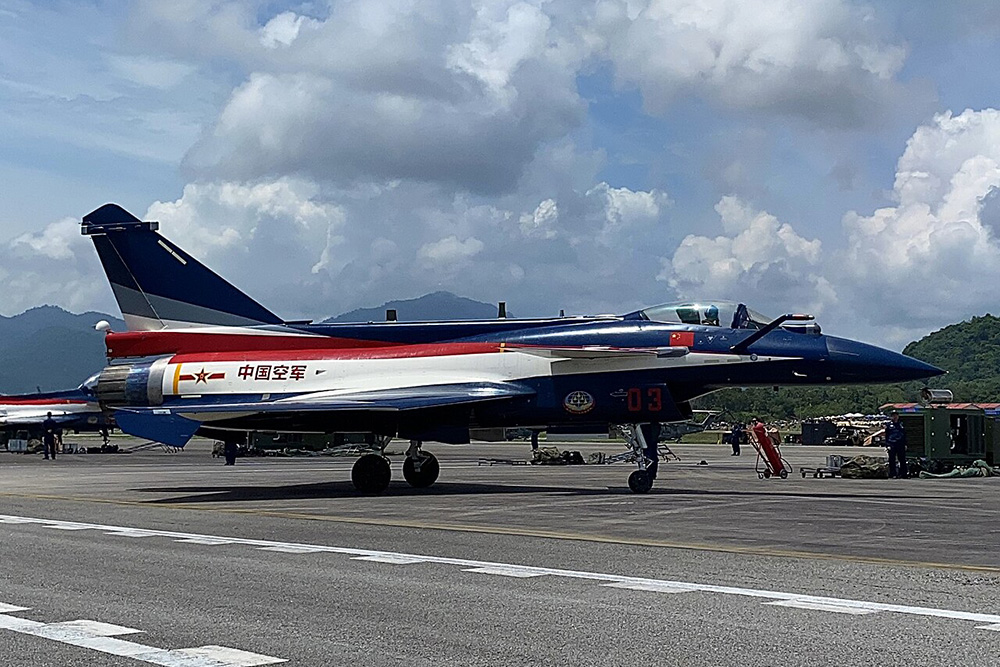
The J-10CY of the demo team Ba Yi looks just like a regular J-10C, but has additionally a large dorsal spine. (photo: Hiroki.loh.st/Wikimedia, modified)
J-10S & J-10SH
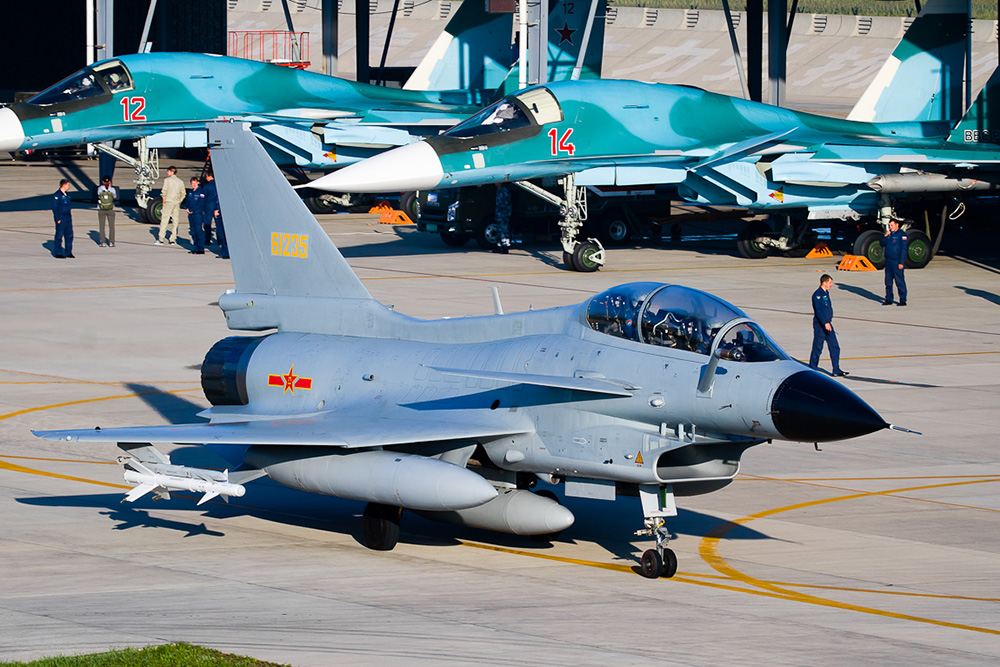
This is the dual seat version of the J-10A, sometimes referred to as J-10AS. Apart from the tandem canopy the external difference is in the dorsal spine that is used for avionics. There is also a naval version of the trainer, called J-10SH (or J-10ASH?). This is externally not different, as far as we know.


.jpg)


The only dual seat J-10 is the J-10S, which is based on the J-10A. Note the curved dorsal spine between the rear of the canopy and the tail. (photo: mil.ru/Wikimedia)
_(5).jpg)
Similar aircraft
Some airplanes look so similar to the J-10 that you may confuse them. Below you can read how to distinguish them.
Differences J-10 & IAI Lavi

Disputably, the J-10 is an improved copy of the Lavi of Israel Aircraft Industries (IAI). Indeed, Chengdu cooperated with IAI when it designed the J-10, based on the Lavi. The air intake of the Lavi is oval though and similar to that of the F-16. The all single wheel gear is also based on that of the F-16. Moreover, the Lavi is a dual seat fighter and has huge ventral fins. (photo: Israeli Air Force/WikiMedia)

Differences J-10 & Eurofighter Typhoon

The Eurofighter Typhoon has the same general appearance as the J-10 but has two engines, fed by separated rectangular air intakes underneath the fuselage. Also, the canards are below the canopy and the EF2000 has a single wheel nose gear.
Differences J-10 & British Aerospace EAP
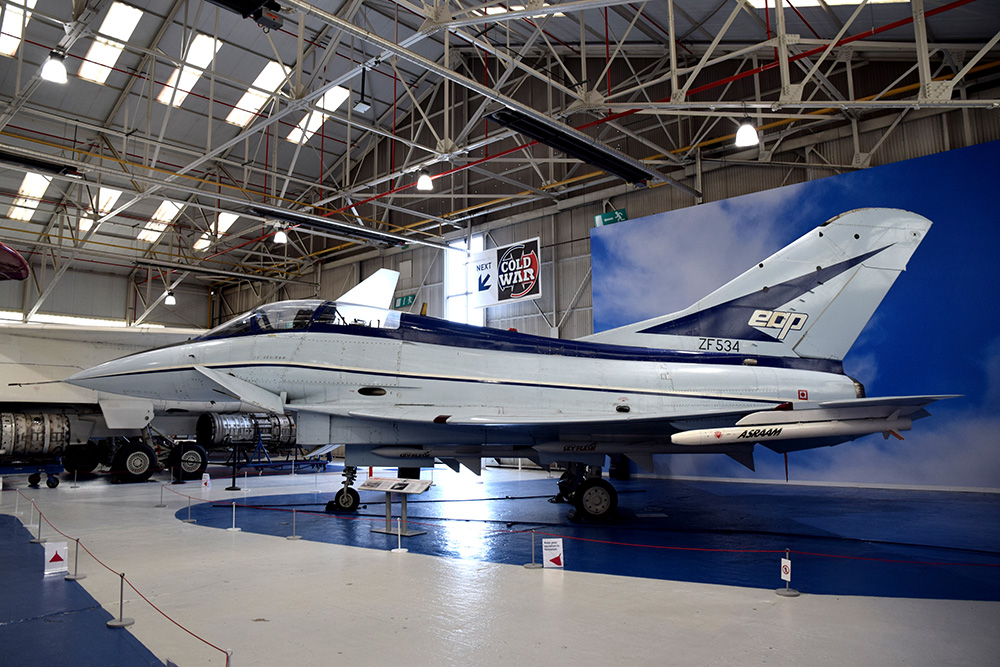
The EAP was the British Aerospace technology demonstrator for the Experimental Aircraft Programme, that formed the basis for the EF2000. Not surprisingly they look similar, and thus also similar to the J-10. The EAP has a relatively large vertical stabiliser, dual non-tilted air intakes and double delta wings. (photo: Hugh Llewelyn/WikiMedia)
.jpg)
Differences J-10 & Dassault Rafale
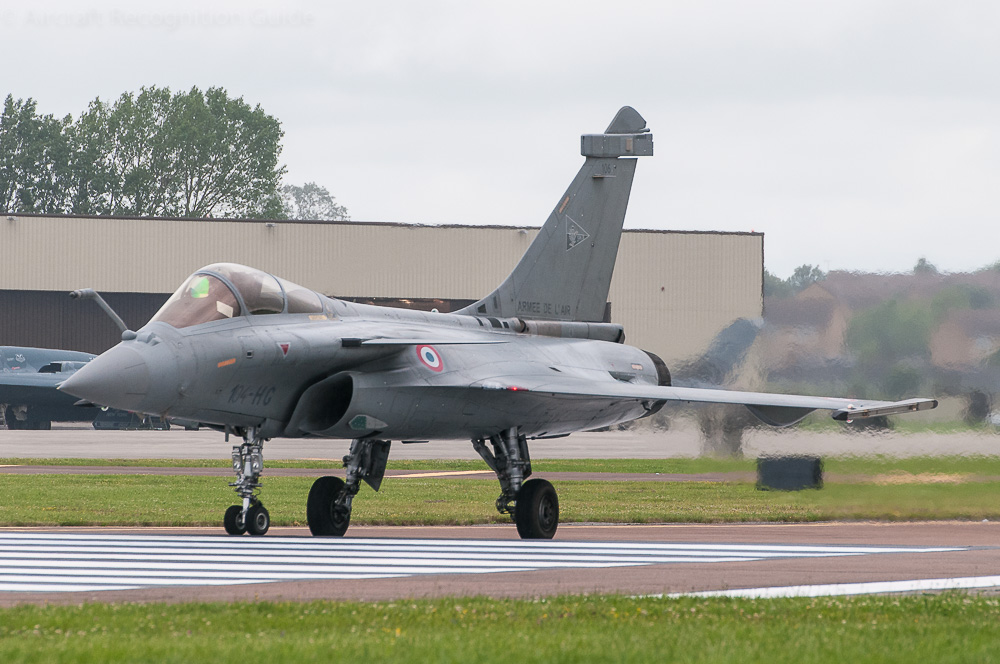
The Dassault Rafale is also a delta wing fighter with canards. The main difference compared to the J-10 is in the air intakes: those of the Rafale have an oval shape and are placed diagonally against the fuselage instead of underneath the fuselage. Also, the Rafale has two engines.