

NHIndustries NH90
It took a long time to develop this helicopter, the NATO Helicopter for the 1990s, hence NH90. While it was launched in 1985, only in 2007 the first examples became operational. And even now, there are still debates about performance issues and operating costs. Still, it is a helicopter you are likely to encounter.
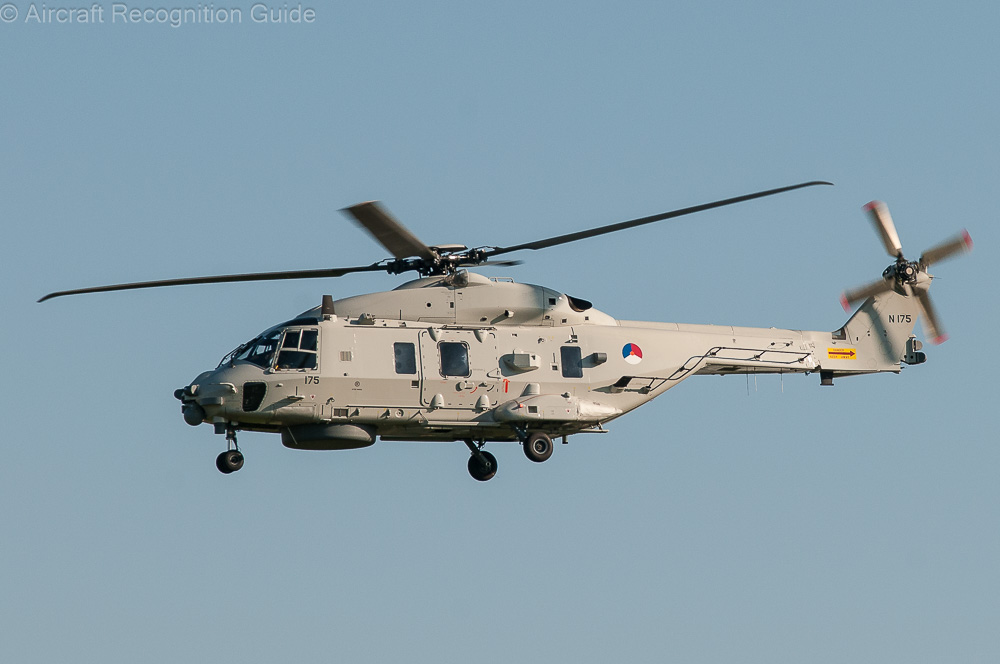
The NH90 is a medium-size helicopter, of which a land and naval version were developed. The appearance is quite conventional, with some exceptions. The first exception is the sharp transition between the upper and lower part of the fuselage, that runs from the nose to the tail boom like the 'bone line' styling of a car. Another characteristic is the tail boom, that end flat, when seen from above. Other features of the NH90 are a four-blade main rotor, a long engine/gar box housing with air intakes at the top, a rear loading ramp and a four-blade tail rotor at the top of the vertical stabiliser. There is a low-mounted, strut-braced horizontal stabiliser with a modest dihedral on the right side. The retractable gear has two wheels at the nose gear and single wheels on the main gears. The latter retract in small sponsons.

The "bone line", where the side of the fuselage curves sharply, is one of the main recognition points of the NH90, as few other helicopters have it this distinctively.

The tail rotor of the NH90 is placed at the top of the vertical stabiliser, where it is ticker than the rest. Note the strut-braced horizontal stabiliser with slight dihedral.
How to recognise the different versions of the NH90
The different basic versions of the NH90 can be distinguished by looking at
- the presence of a rear loading ramp
- the presence of a disk shaped radome under the fuselage
- whether the main rotor blades can be folded
Each country can customise the basic version further, which could lead to additional differences within a basic variant.
NH90-MSPT
Especially made for the Spanish navy, the NH90-MSPT (Multi-Role Support Transport) is essentially an NH90-NFH without the disk radome under the fuselage. Instead, there is a smaller bulge in the nose. For the rest, the MSPT version has folding main rotor blades, but no rear loading ramp.

The Spanish navy is the sole operator of the NH90-MSPT, with folding blades but no rear loading ramp.
NH90-MTT
MTT stands for Maritime Tactical Transport, and is a mix of the NFH and TTH variants. So the NH90-MTT has a rear loading ramp and folding main rotor blades, but no radome. Only the Italian navy has this version, designated as MH-90A.
From a distance the MH-90A (NH90-MTT) is not easily distinguished from the other variants.
NH90-NFH & NH90-MRFH
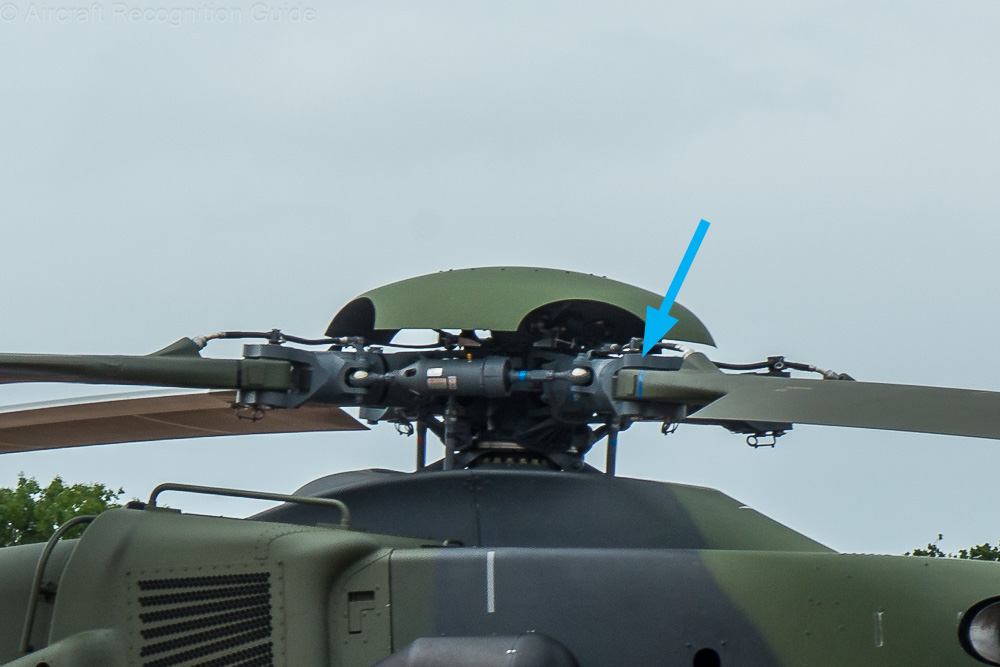
Meant specifically for naval operations, the NATO Frigate Helicopter (NFH) variant has a large disk shaped radome under the front fuselage. Additionally, its main rotor blades can be folded. Therefore, the blade attachment is different from the TTH variant. Finally, the NFH has no rear loading ramp.
The German navy calls this version the Sea Lion when used in the SAR role. It is supposed to have fewer sensors. The Italian navy calls it SH-90A and the French navy Caïman.
A slightly separate version is the NH90-MRFH (Mulit-Role Frigate Helicopter), called Sea Tiger by the German navy. It has the capability to launch torpedos, from special pylons against the side of the fuselage.


NH90-TTH
The other main variant of the NH90 is the TTH, Tactical Transport Helicopter. The NH90-TTH has no folding main rotor blades and no dish shaped radar under the fuselage. It can however be equipped with a two-piece rear loading ramp. To protect the lower part from being scratched when open to the ground, it has two bumps on the sides.
Various military customers have given specific designations to the NH90-TTH: UH-90A by the Italian army, MRH-90 Taipan by the Australian army, Caïman by the FRench army and Caimán by the Spanish army.
The Swedish army has a high cabin version (HCV) of the NH90-TTH, designated Hkp14. The difference compared to the standard TTH is especially visible near the eyebrow cockpit windows and the curve or the 'body line' near the tail boom.



Similar helicopters
Some helicopters look so similar to the NH90 that you may confuse them. Below you can read how to distinguish them.
Differences NH90 & EH101/AW101

While the EH101/AW101 significantly larger than the NH90, and has no 'bone line' and has three engines, they are still similar in appearance thanks to the rear loading ramp, square cabin windows and tail area. Other differences are that the EH101/AW101 has - in most cases - a twin wheel main gear, and a five-blade main rotor.
Differences NH90 & AW149/AW189

The AW149/AW189 is similar in size as the NH90, and has a 'bone line', a twin wheel nose and single wheel main gear as well. But there are many differences: a longer nose, five-blade main rotor, a tail rotor on the right side and bent up tips of the horizontal stabilisers.
Differences NH90 & H175
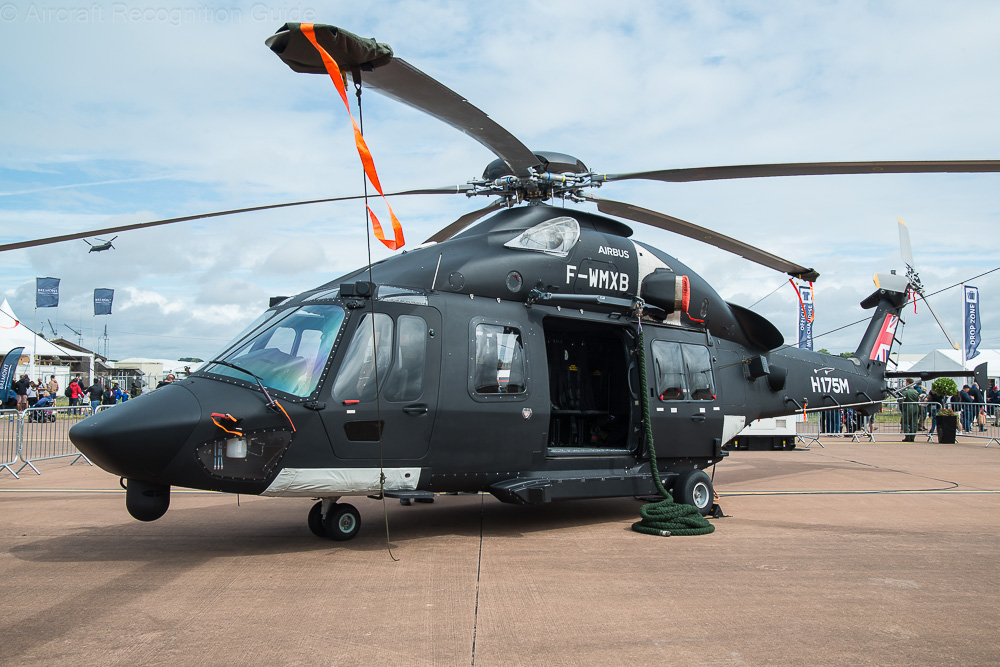
The slightly smaller Airbus H175 also has a 'bone line', but less pronounced, and a two wheeled nose gear. However, this helicopter has a relatively large engine/gear box housing (creating a 'waterhead' appearance), a five-blade main rotor and a three-blade tail rotor. Finally, it has no rear loading ramp.
Differences NH90 & Bell 525 Relentless
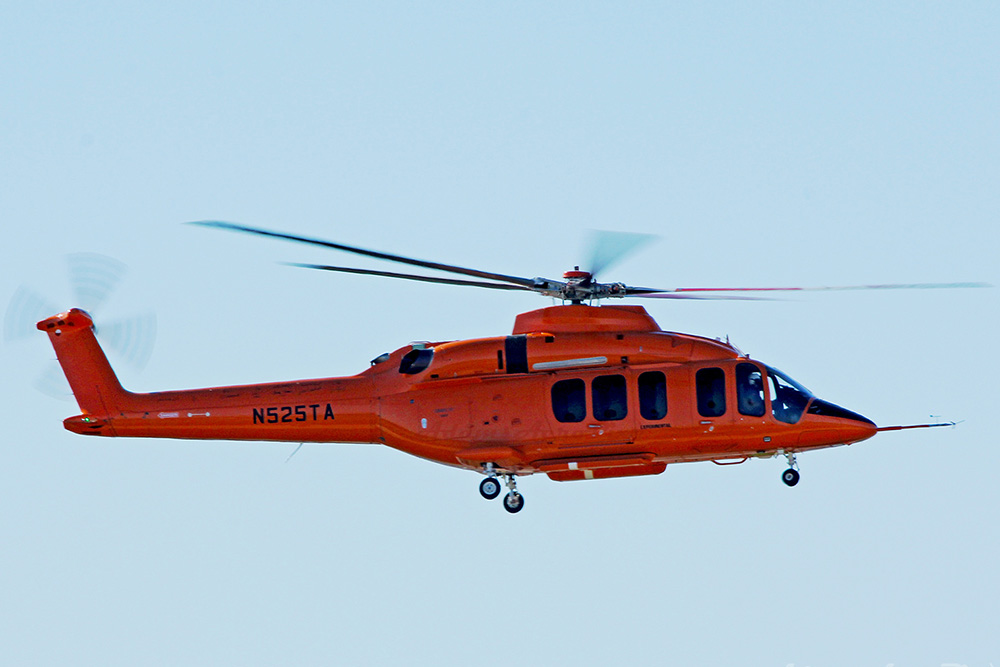
This slender helicopter has a five-blade main rotor like the others confusion candidates, as well as a similar landing gear. And like the others the Bell 525 also lacks a rear loading ramp. Moreover, it has a large pylon on top of the engine/gear box housing. (photo: Zane Adams/WikiMedia)
Differences NH90 & Westland WG30
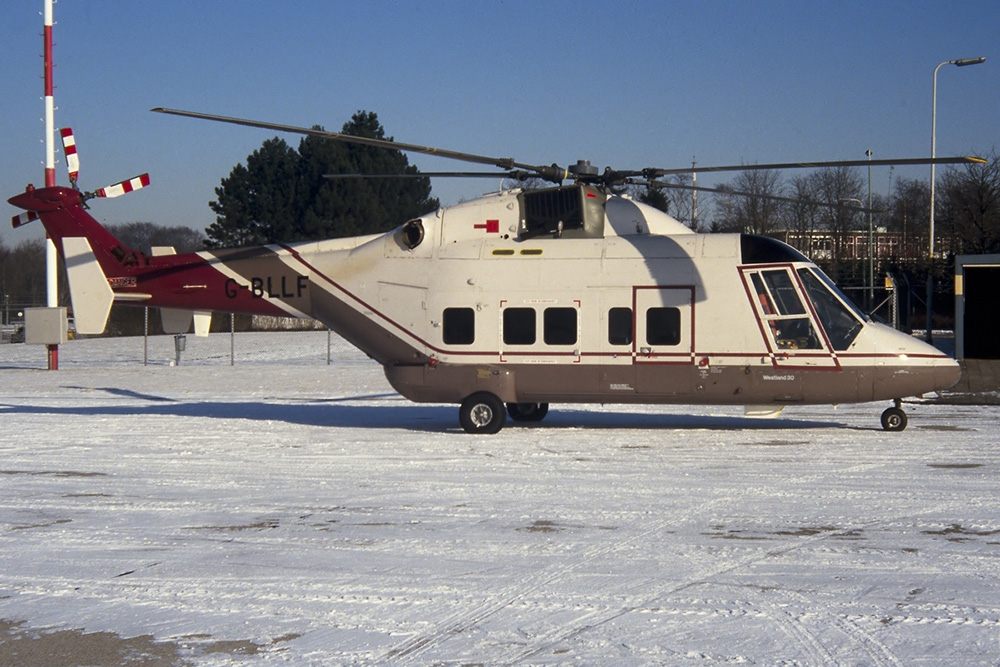
Essentially, the Westland 30 is a Westland Lynx with a larger fuselage, that makes it look like an NH90. It sits close to the ground with its fixed gear, that has single wheels on the main leg and two on the nose leg. Other features are five square cabin windows and horizontal stabilisers with large end plates close to the tail. (photo: Peter Bakema/WikiMedia)
,_Netherlands_PP1364922698.jpg)
Differences NH90 & SA330/AS532/H225

Typical for the AS332 and AS532 (and later EC225/EC725/H225) is the location of the engines: at the front of the engine/gear box housing with the intakes above the cockpit. That makes it already significantly different from the NH90, as is the five-blade tail rotor on the right and high-mounted horizontal fin on the left.